

Start with the Operating Environment
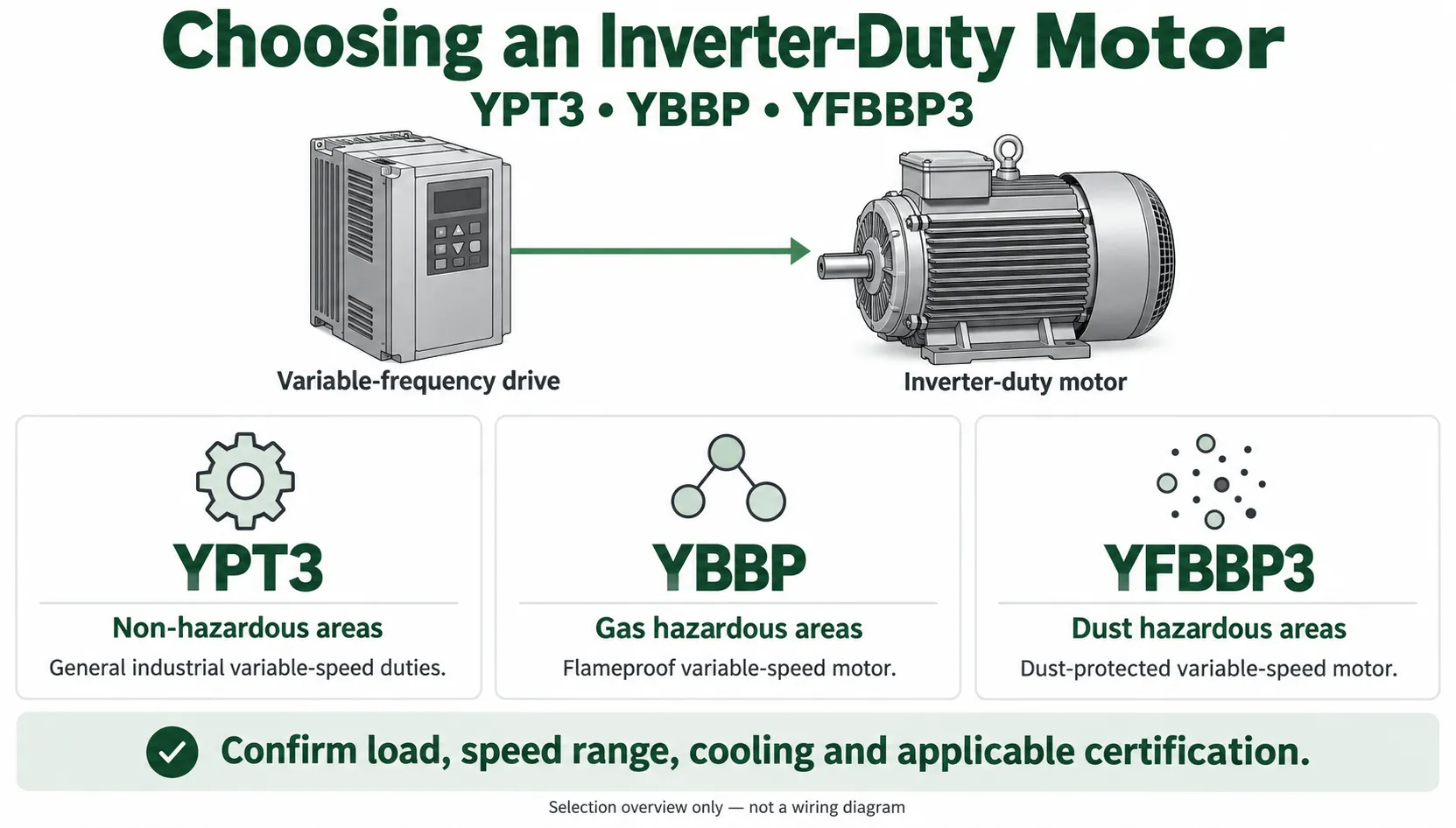
YPT3, YBBP and YFBBP3 are Shangli motor series intended for variable-frequency operation, but they are not interchangeable. The first selection question is whether the motor will operate in a non-hazardous location, an explosive gas atmosphere or a combustible dust atmosphere.
Once the environment is defined, check the required torque, speed range, cooling arrangement and compatibility with the variable-frequency drive (VFD). Power rating alone is not enough to select the complete motor configuration.
YPT3, YBBP and YFBBP3 Compared
| Series | Application Direction | Catalogue Features | Key Selection Check |
|---|---|---|---|
| YPT3 | General industrial variable-speed duties in non-hazardous locations | Insulation system intended for inverter supply; IP55 protection and IC416 cooling described in the catalogue | Required torque across the speed range, drive compatibility and cooling-fan supply |
| YBBP | Variable-speed duties requiring flameproof protection for explosive gas environments | Flameproof construction and a separately driven axial cooling fan | Applicable protection marking, certification scope and permitted converter-fed operating conditions |
| YFBBP3 | Variable-speed duties requiring protection against combustible dust hazards | Totally enclosed, forced-air-cooled construction with dust explosion protection | Dust classification, permitted surface temperature, certification scope and cooling conditions |
This comparison provides an initial selection direction. Final ratings, accessories and approvals must be confirmed for the exact motor supplied. Gas protection does not automatically establish dust protection, or vice versa.
YPT3: General Industrial Variable-Speed Operation
YPT3 is the starting point among these three series for applications that require variable-speed operation without an explosion-protection requirement. Shangli’s catalogue describes an insulation system intended for inverter supply, with IP55 enclosure protection and IC416 cooling.
The catalogue describes a typical 380 V, 50 Hz rated configuration, with constant-torque operation from 5 to 50 Hz and constant-power operation from 50 to 100 Hz. These are catalogue operating ranges, not permission to run every model and driven machine at any speed within them.
Confirm the actual motor rating, permissible speed, load characteristics and cooling requirements for your selected configuration.
YBBP: Flameproof Variable-Speed Operation
YBBP combines variable-frequency operation with flameproof construction. The catalogue describes a separately driven axial fan to support cooling at different motor speeds. It also describes constant-torque operation from 5 to 50 Hz and constant-power operation from 50 to 100 Hz.
For a hazardous-area installation, the selected motor must match the project’s gas classification, temperature requirements and required approvals. The permitted operating range must also agree with the motor documentation and applicable certification conditions.
A general certificate for a motor series should not be treated as automatic approval for every motor, drive and operating combination.
YFBBP3: Variable-Speed Operation in Dust Hazardous Areas
YFBBP3 is described in Shangli’s catalogue as a totally enclosed, forced-air-cooled variable-speed motor for combustible dust environments.
Selection requires the site’s dust hazard information, ambient conditions and required protection marking. Confirm the model’s permitted surface temperature, operating range and applicable certification before ordering.
Do not assume that an enclosure IP rating alone establishes suitability for a combustible dust atmosphere. Similarly, do not transfer the operating ranges of another motor series to YFBBP3 without checking its specific data.
Understand the Torque Requirement
A frequency range does not fully describe a motor’s ability to drive a machine. The required torque at low speed, during starting and throughout normal operation must also be considered.
Constant-torque operation: the motor can provide approximately constant torque within its specified operating limits. Available mechanical power reduces as speed reduces.
Constant-power operation: available torque decreases as speed increases within the specified constant-power range.
Provide the driven equipment’s torque-speed requirements, starting conditions and overload demands wherever possible. Also confirm the maximum permissible speed of the driven machine, coupling and transmission.
Why Cooling and Drive Compatibility Matter
Low-speed operation can limit the cooling available from a shaft-driven fan. Independent ventilation can support cooling, but the fan supply, airflow and permitted load still need to be confirmed.
Motor selection must consider the drive as well as the motor. Provide the VFD make and model, available supply information, approximate motor-cable length and any proposed filters. These details help the technical review of the motor-drive arrangement.
For hazardous-area motors, follow the required thermal protection and operating conditions stated in the applicable certificate and instructions. This guide is an enquiry aid, not an installation or commissioning procedure.
What to Include in Your Enquiry
Driven equipment and required rated output.
Supply voltage and frequency.
Minimum, normal and maximum operating speeds.
Starting torque, load profile and operating duty.
VFD make, model and available drive specifications.
Mounting arrangement and dimensional requirements.
Ambient temperature, altitude and cooling conditions.
For hazardous areas, the site classification, required protection marking and certification requirements.
Any required temperature monitoring or anti-condensation heaters.
Quantity, destination and requested delivery date.
Discuss Your Variable-Speed Application
If you are unsure which series to consider, start by sending the equipment application, operating environment and required speed range. For a replacement, include the existing motor nameplate and drive information.
Email your enquiry to [email protected]. Our team can review the available information and identify the specifications that need confirmation before quotation.