

What Is the Main Difference Between Y, YKS and YKK?
In Shangli’s high-voltage motor catalogue, the main distinction between Y, YKS and YKK is the cooling arrangement and associated enclosure configuration. The Y range includes open-ventilated and duct-ventilated configurations. YKS uses an air-to-water heat exchanger, while YKK uses an air-to-air heat exchanger.
Start by considering the installation environment and available cooling utilities. Then confirm the motor’s electrical ratings, starting requirements, mechanical interface and protection level. The series name alone is not a complete specification.
Cooling and Protection Compared
| Series / Configuration | Cooling Code | Cooling Arrangement | Protection Listed in the Catalogue |
|---|---|---|---|
| Y — Open-ventilated | IC01 | Open ventilation using surrounding air | IP23 |
| Y — Duct-ventilated | IC11 | Ducted ventilation | IP44 |
| YKS | IC81W | Enclosed motor with an air-to-water heat exchanger | IP44 or IP54 |
| YKK | IC611 | Enclosed motor with an air-to-air heat exchanger | IP44 or IP54 |
These are the configurations described in Shangli’s catalogue. Confirm the cooling code and IP rating for the exact motor offered in the quotation and technical documentation.
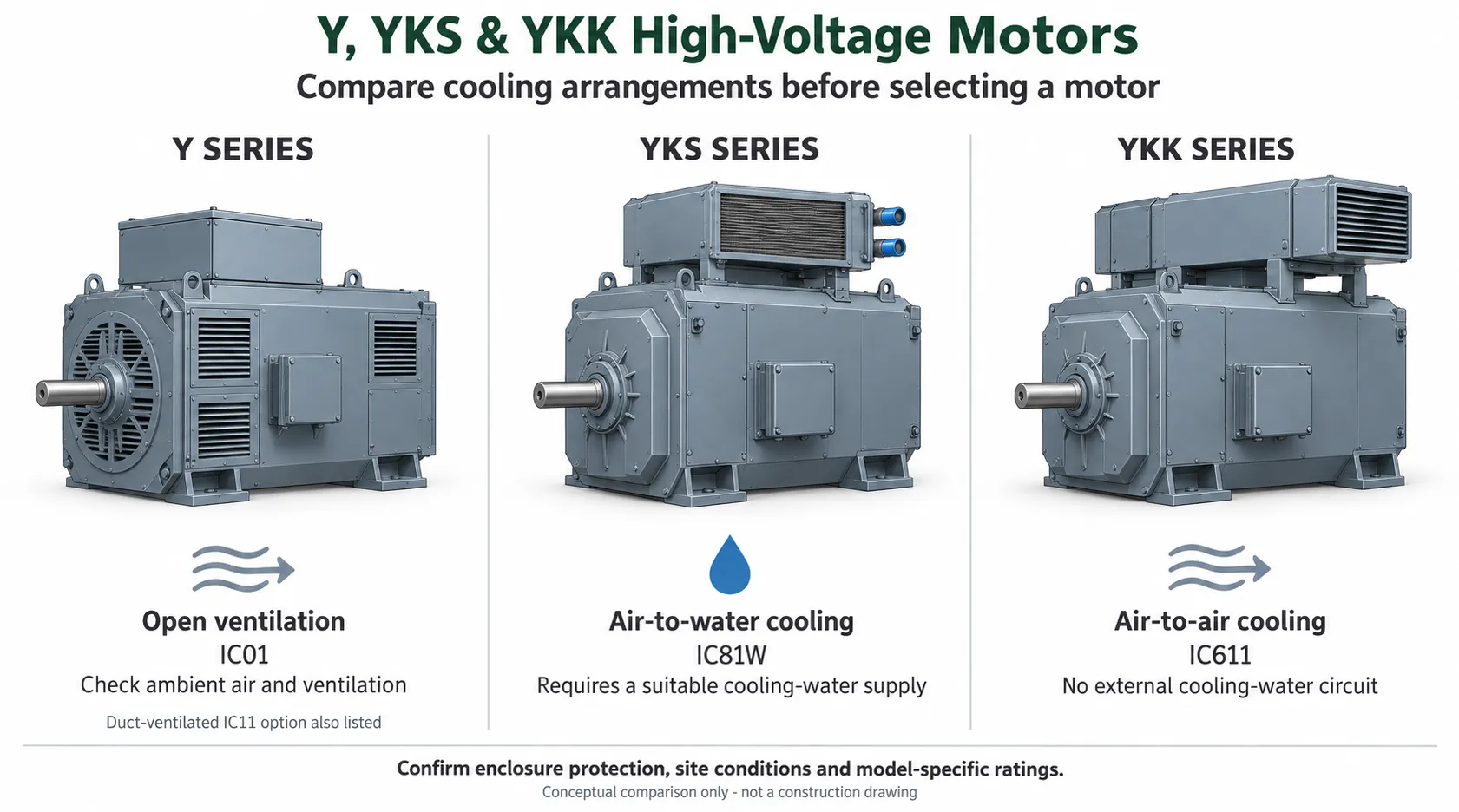
Y Series: Open or Ducted Ventilation
The open-ventilated Y configuration uses surrounding air for cooling. The suitability of the cooling air is therefore an important part of the selection review.
Describe the motor-room conditions, including temperature, dust, moisture and any corrosive contaminants. Also identify restrictions around air openings and the route by which heated air leaves the installation.
The catalogue also lists a duct-ventilated IC11 configuration. If ducting is required, provide the proposed arrangement and site ventilation information so that its suitability can be reviewed. Do not assume that a standard open motor can be converted simply by attaching a duct.
YKS Series: Air-to-Water Cooling
YKS uses an air-to-water heat exchanger to remove heat from the motor’s internal cooling air. The cooling water belongs to the heat-exchanger circuit; it does not circulate directly through the motor windings.
This arrangement requires a suitable cooling-water supply. Before requesting a quotation, provide the available water inlet temperature, flow, pressure and water-quality information. The required values must be confirmed for the selected motor.
Include the proposed pipe connections, maintenance access and any project requirements for monitoring the cooling system. Do not assume that seawater or untreated process water is acceptable without a specific technical review.
YKK Series: Air-to-Air Cooling
YKK uses an air-to-air heat exchanger. Heat from the internal air circuit is transferred to an external air circuit, without requiring an external cooling-water supply.
The absence of a water circuit does not remove the need for ventilation planning. Provide the ambient temperature, available space around the cooler and any conditions that could restrict airflow or cause dirt to accumulate.
Confirm the space needed for inspecting and cleaning the cooler as well as the overall motor dimensions.
Which Arrangement Should You Consider?
| Site Situation | Initial Direction for Review |
|---|---|
| Suitable ambient cooling air is available and the project permits an open enclosure. | Consider the Y open-ventilated configuration, subject to the required protection and site conditions. |
| The installation requires a ducted ventilation arrangement. | Discuss the Y duct-ventilated configuration together with the proposed duct system. |
| An enclosed motor is required and a suitable, reliable cooling-water supply is available. | Consider YKS and confirm the water-circuit requirements. |
| An enclosed motor is required without an external cooling-water circuit. | Consider YKK and confirm ambient-air cooling conditions. |
These are starting points, not automatic selection rules. Compare the complete installation, including utilities, maintenance access and the driven equipment’s requirements. There is no single cooling arrangement that is best for every project.
Catalogue Ratings: Use the Range Carefully
Shangli’s combined Y, YKS and YKK catalogue overview lists frame sizes 355–630, outputs from 220 to 3,150 kW, voltages of 3, 6 and 10 kV, pole counts from 2 to 12, and a frequency of 50 Hz. It also describes horizontal foot mounting, IM B3, and Class F insulation with temperature rise assessed to Class B limits.
These figures describe the overall catalogue range. They do not establish that every power, voltage, pole count and cooling arrangement is available in every series or frame size. Request a model-specific technical data sheet for the proposed motor.
Check More Than Cooling
Starting performance: provide the driven equipment’s starting conditions, load torque, inertia and any limits on starting current.
Mechanical compatibility: confirm mounting dimensions, shaft details, coupling requirements and overall installation space.
Bearings and lubrication: confirm the bearing arrangement and any required lubrication services for the selected model.
Drive method: state whether the motor will operate from the supply directly or through a variable-frequency drive. Converter suitability must be reviewed separately.
Operating environment: provide ambient temperature, altitude, indoor or outdoor location and relevant contamination or corrosion conditions.
Hazardous areas: an enclosed construction or an IP rating does not establish explosion protection. Request a motor with the appropriate protection and certification for the site.
Prepare Your High-Voltage Motor Enquiry
Send the required output, voltage, frequency, speed, driven-equipment details and starting method. Include the preferred cooling arrangement, site conditions, available utilities and any project specification.
For a replacement, add the existing nameplate, dimensional drawing and photographs of the installation. If you are comparing Y, YKS and YKK options, explain whether cooling water is available and whether an open-ventilated motor is acceptable.
Email your requirements to [email protected] so the Shangli team can review the configuration and information needed for a quotation.